



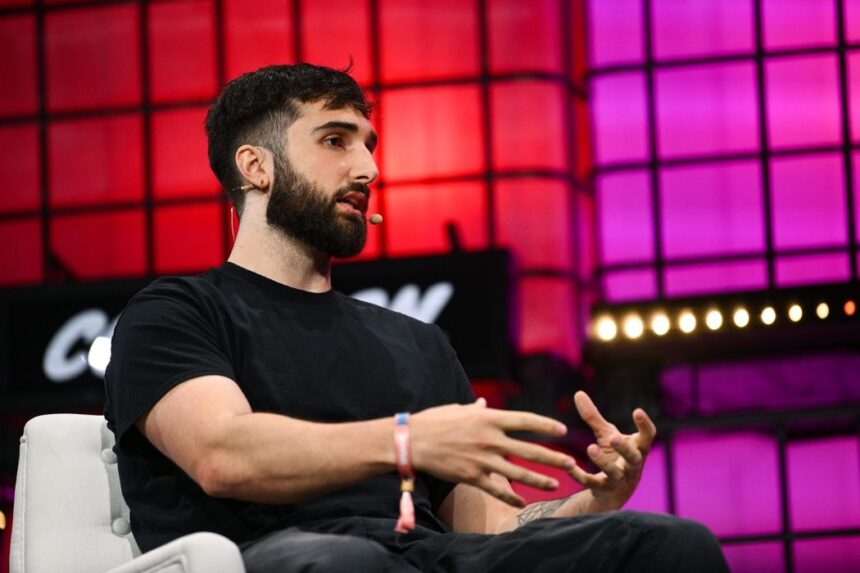
Cohere co-founder Nick Frosst is surrounded by chatter about artificial general intelligence, or AGI. He’s perfectly happy to stay out of the conversation.
Founded in 2019, by ex-Google AI researchers, Cohere is valued in the billions of dollars and is one of the more high-profile names in the world of generative AI, which has exploded since OpenAI debuted ChatGPT in late 2022.
But it’s not a company that’s well known among consumers, who have swarmed to chatbots and other tools from OpenAI, Google and Perplexity. Rather, Cohere is all about business.
“I’m in meetings with companies in health care, banking and IT all the time,” Frosst told . “The questions I get are about securely automating tasks like HR, payrolls, research and fraud detection to drive productivity. No one has ever asked me about achieving AGI, let alone ASI.”
The latter is short for artificial superintelligence, or AI that significantly surpasses human intelligence. OpenAI and Anthropic have both made it their goal to achieve it.
In its latest funding round in July, Cohere raised $500 million at a $5.5 billion valuation, more than doubling its valuation from the prior year. Investors in the company include Nvidia, AMD, Salesforce and Oracle.
While that would historically be a huge price tag for a company that’s not even 5 years old, it’s a fraction of what investors are paying for OpenAI, valued at $157 billion in a round announced in October, and Anthropic, which CNBC confirmed this week is in talks to raise funding at a $60 billion valuation.
Some of Cohere’s chief competitors in the AI arms race offer products for both consumers and businesses. OpenAI, for instance, launched ChatGPT Enterprise in 2023, and Anthropic rolled out Claude Enterprise in September.
Frosst said Cohere’s preference for the enterprise is centered around the idea that large language models are best at automating tedious tasks and “being a co-worker.”
“Really, it’s an automation tool,” Frosst said. “When I think about my personal life, there’s actually not a ton that I want to automate. I don’t want to write text messages to my friends faster. I don’t want to respond to emails more efficiently in my own life. But in my work life, I really, really do want to do that.”
Frosst said, “I want to be free to think creatively and not be bogged down.”
Cohere co-founder Nick Frosst is surrounded by chatter about artificial general intelligence, or AGI. He’s perfectly happy to stay out of the conversation.
Founded in 2019, by ex-Google AI researchers, Cohere is valued in the billions of dollars and is one of the more high-profile names in the world of generative AI, which has exploded since OpenAI debuted ChatGPT in late 2022.
But it’s not a company that’s well known among consumers, who have swarmed to chatbots and other tools from OpenAI, Google and Perplexity. Rather, Cohere is all about business.
“I’m in meetings with companies in health care, banking and IT all the time,” Frosst told. “The questions I get are about securely automating tasks like HR, payrolls, research and fraud detection to drive productivity. No one has ever asked me about achieving AGI, let alone ASI.”
The latter is short for artificial superintelligence, or AI that significantly surpasses human intelligence. OpenAI and Anthropic have both made it their goal to achieve it.
In its latest funding round in July, Cohere raised $500 million at a $5.5 billion valuation, more than doubling its valuation from the prior year. Investors in the company include Nvidia, AMD, Salesforce and Oracle.
While that would historically be a huge price tag for a company that’s not even 5 years old, it’s a fraction of what investors are paying for OpenAI, valued at $157 billion in a round announced in October, and Anthropic, which CNBC confirmed this week is in talks to raise funding at a $60 billion valuation.
Some of Cohere’s chief competitors in the AI arms race offer products for both consumers and businesses. OpenAI, for instance, launched ChatGPT Enterprise in 2023, and Anthropic rolled out Claude Enterprise in September.
Frosst said Cohere’s preference for the enterprise is centered around the idea that large language models are best at automating tedious tasks and “being a co-worker.”
“Really, it’s an automation tool,” Frosst said. “When I think about my personal life, there’s actually not a ton that I want to automate. I don’t want to write text messages to my friends faster. I don’t want to respond to emails more efficiently in my own life. But in my work life, I really, really do want to do that.”
Frosst said, “I want to be free to think creatively and not be bogged down.”