



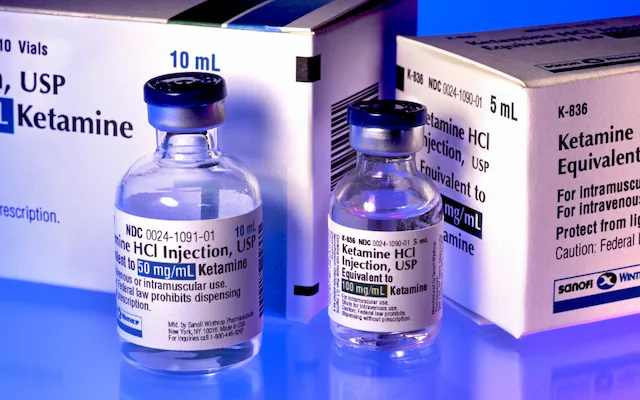
Ketamine is increasingly known as a party drug which is linked to serious health problems, even fatalities.
But there is growing interest in Scotland in its potential to treat severe depression.
One NHS Lothian psychiatrist hopes to set up a clinic by the end of the year offering the Category B drug as an alternative to electroconvulsive therapy (ECT), a treatment that involves sending an electric current through the brain.
Prof Andrew McIntosh thinks it could offer another alternative to patients with the most hard-to-treat depression.
The move comes after a private clinic in Lanarkshire began offering ketamine assisted therapy to clients with treatment-resistant depression last summer.
The Eulas clinic in Hamilton opened under licence from Healthcare Improvement Scotland in September and charges £6,000 for a programme of four intravenous ketamine infusions and a course of psychotherapy.
Ketamine is a medical anaesthetic and while it is not licensed for the routine treatment for depression, it can be used ‘off-label’ by doctors and psychiatrists.
Alex, who recently moved to Scotland from the United States, is one of 12 people being treated at the clinic.
She has experienced periods of depression and anxiety and says she turned to ketamine assisted therapy when traditional treatments didn’t help.
“I was crying all day long while I was working, and was very resistant to doing anything new,” the 40-year-old said.
Ketamine, which is illegal on the streets, has nevertheless been used as a recreational drug for years because of its detached, dream-like effects.
“I definitely had a psychedelic experience,” Alex said.
“You would see images, kind of feel like you’re floating sometimes.
“If you’re reclined, you might feel like you’re floating into different spaces for example. Or like you’re going down a waterslide.”
Alex believes the infusions made her more receptive to psychotherapy.
“I think it makes it more palatable almost,” she says.
“You may see an image and you’ll remember this image and then you’ll talk to your therapist and they’ll say: ‘That’s interesting, why do you think you saw that? What does that represent to you?”
Alex had already tried ketamine therapy in the United States before being treated in Scotland and thinks it should be more widely available here.
“Before, I was really depressed,” she said
“Now I feel like I’m doing pretty well. I am active, I am trying new things, traveling again, kind of getting back to the person I felt like I used to be.”
Sean Gillen, the director of the Eulas clinic, says patients must have a diagnosed condition and be assessed by a psychiatrist to qualify for treatment.
He admits the cost of ketamine assisted therapy may be out of reach for many and hopes it will soon be available on the NHS.
“You’re dealing with psychiatrists, anaesthetists, psychotherapists – these are real professional people and they need to be paid,” he said.
“Most people don’t have that kind of money and that’s why we’d like to enter a partnership with the NHS.”
Ketamine is licensed as an anaesthetic but has hit the headlines for its recreational use.
It can cause serious and sometimes permanent damage to the bladder, alongside a range of other complications if misused.
It was linked to the death of RuPaul’s Drag Race UK star The Vivienne earlier this year.
And a coroner found Friends actor Matthew Perry died of the ‘acute effects of ketamine’ in 2023.
Esketamine, a form of ketamine taken as a nasal spray, has been approved for the treatment for moderate to severe treatment-resistant depression in Scotland but intravenous ketamine has not, though it can be prescribed ‘off-label’.
The Royal College of Psychiatrists has previously urged caution over the use of ketamine therapy but it is due to publish a new report on psychedelics later this year, with updated information on ketamine.