



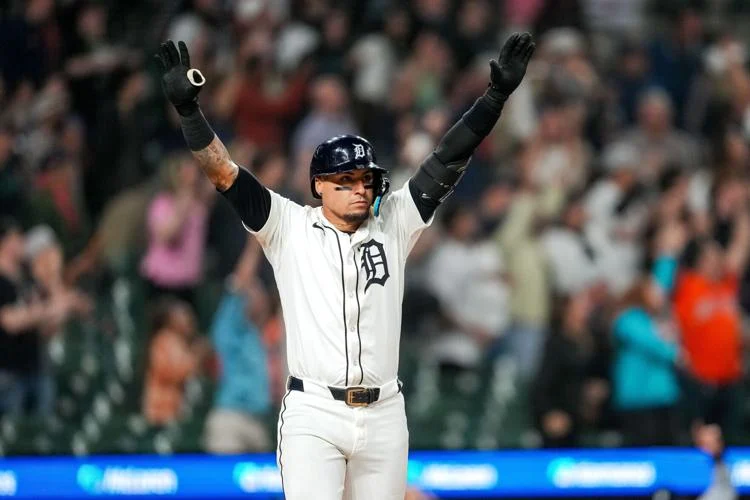
Javier Báez came to Detroit as a two-time All-Star, a Gold Glove winner, the spark plug known as “El Mago” who helped the Chicago Cubs shake off a century of futility to win a championship in 2016.
In late 2021, all his work paid off: The Detroit Tigers gave him a six-year, $140 million contract to make him the cornerstone star who would at last turn their rebuilding project into playoff success.
Instead, the mega-signing looked like a bust. Over two-and-a-half difficult, injury-plagued seasons, Báez played so poorly he became a baseball meme. His frequent swings at pitches outside the strike zone were mocked by fans around the league. He ended the 2024 season with a .184 batting average, the dour exclamation mark on his worst campaign since his abbreviated first year in the league 10 years earlier. In August 2024, Baez’s season ended early as the hip and lower back issues that hampered him all year finally grew to be too much to bear.
How bad was his crash? Detroit sports fans don’t really like to boo their hometown players. It’s not like New York, Boston or Philadelphia, where making one’s displeasure known is as reflexive of an act as breathing. In Detroit, underperforming stars and teams are usually met with empty stands, uncomfortable silences, light grumbles – at most, loud sighs of exasperation. Booing was reserved for squads like the mid-2000s Lions, teams that were so historically underperforming that the emotional scars from those years still lurk just beneath the surface of Detroit fandom.
That’s how you know things were really, really bad for Javier Báez during those first three rotten years in the Motor City: The boos at Comerica Park were plenty noticeable.
Báez heard them, too. He says he didn’t mind.
“The fans are going to be fans. They give their opinions when they count and when they don’t count. So, I do play for the fans – I don’t play for their opinions, you know?” . “I know what I can do, I know what I’ve done.”
Weirdly, with their highest-paid player injured and out of the lineup, the Tigers got hot last year, making one of the most unlikely surges to get into the MLB playoffs in recent memory. Báez stayed with the team, watching from the dugout as the franchise’s future suddenly seemed bright while his own remained filled with doubt. He entered spring training as – at best – an afterthought.
Instead, this season the 32-year-old Puerto Rican has revived his career, turning those boos into cheers as he’s found ways to contribute that no one would have expected. He celebrated 10 years of service time in the major leagues on Tuesday with two home runs, reaching a major milestone with aplomb.
“It’s really fun, man,” Báez said about his team after a recent game. “They have a lot of fun here. We always stay together. And you know, that was one of the reasons why I came here. I saw the other prospects coming up, and this was going to make a good team in the future. And you know, the future is – obviously, we doing it right now.”
Coming off the roster
The seeds of a successful 2025 were sown during the dog days of 2024. Earlier in that season, inflammation in his lower back put him on the injured list for nearly a month. He came back into the lineup for most of July but then had issues with his lower back and hips flare up again in August.
The difficult decision was made to shut him down for the rest of the year on August 26, after a return to Wrigley Field, where he had played for the Cubs for more than seven seasons.
“It was really hard, man, for me to get out the lineup, and to be out for the last two months of the season,” Báez said. “It was really difficult to take that decision, but I knew I needed to.”
Arthroscopic surgery on Báez’s right hip was aimed at relieving the inflammation that plagued the utility player’s lower back and contributed in a big way to his struggles at the plate. Swinging a bat puts immense pressure on a player’s core and lower back with the repetitive twisting, translating power generated from the legs into the torque needed to smack a 95-mile-per-hour fastball over a fence more than 300 feet away.
For a free-swinging player like Báez who likes to take big, powerful cuts at the ball, it was incredibly limiting. His swings – hard as ever at an average of 74.8 miles per hour, according to MLB’s Baseball Savant statistics service – were getting more expansive each season in Detroit. His stance was much more open than it had been the previous season. He was out of whack and couldn’t find the magic that made him “El Mago” (“The Magician”) in the first place.
In 2025, he’s shortened his swing, closed off his batting stance and moved up in the box, MLB’s analysis tool Baseball Savant shows. It’s tweaks like that and the freedom to play with much less pain – there’s never truly a lack of pain for professional athletes who ply their trade every day – that have helped the slugger feel comfortable in the box again.
“Everything is getting better – as a team, as an organization, as an experience. But you know, the only difference for me is being healthy,” . “I’m feeling healthy. I feel good. I’m making adjustments, and, you know, I’m playing better. I’m playing better for myself, and I’m playing better for the team.”
Slowing down the game
A rebuilding team can take time to let players work out issues at the major league level. Teams in contention – those that want to win now – don’t have that luxury.
And so, the Tigers front office and manager AJ Hinch had a tough question staring at them as the 2025 season loomed: If Detroit wanted to make a run deep into October in 2025, could the franchise really afford to let Báez prove that these last few years were an aberration and not a sign of permanent, catastrophic decline?
Hinch was relieved to see that the changes in Báez’s performance came fast once this season began. That the Tigers had won last year without him leading the way has allowed Báez to play more relaxed. The team is solid and confident; he’s no longer expected to lead everyone to playoff glory.
Instead, Báez is one of the league’s highest-paid role players, doing whatever it takes to win.
In offseason conversations about how he could best contribute, Hinch stressed to Báez that he needed versatility from the veteran. Báez said he was all in.
“I’ve been doing it all my career, you know? Kind of got away from it a little bit when I started playing short, when I signed with the Tigers, but I’ve been playing all over the field all my career,” he told reporters.
He willingly moved from the shortstop position – including more than 30 starts in centerfield, a position that he had never played before in an MLB game. There he showed impressive range and a high-quality arm that made him a natural in Comerica Park’s expansive outfield grass.
Then the bat – the most mystifying part of Báez’s game, the part of the game that can make him a hero or a pariah (and often both, in the same game) – came around.
The hits came slow at first and then, in late April, things clicked. The batting average started to rise, the home runs started to come. Suddenly, it seemed like Báez’s reputation as an automatic out might be a thing of the past.